Ask how many pharmaceutical companies operate in Ethiopia and you can get four defensible answers before lunch. AddisBiz’s business directory lists 181 companies under “Pharmaceutical / Medicine Importers and Suppliers.” 2merkato lists 107 under “Medicines/Pharmaceuticals.” The Ethiopian Food and Drug Authority (EFDA)‘s own published list of licensed importers and wholesalers, dated March 2019, names 206 businesses. None of those three numbers is wrong. They count different things, on different dates, with different rules for who gets dropped off the list, and we checked all of them directly rather than repeating a figure we found in a search result.
“Pharmaceutical company” covers five different licences
The first reason the numbers disagree is that Ethiopian regulation does not license one thing called a “pharmaceutical company.” It licenses positions along a supply chain, and one business can hold more than one licence at once. A 2025 review in Frontiers in Medicine sets out the tiers: an importer brings product into the country, a wholesaler distributes it onward, and three retail tiers reach the patient directly, each requiring a different level of qualified staff.
- Importer. Brings finished pharmaceuticals or raw materials into Ethiopia. Requires an EFDA competence certificate and trading licence.
- Wholesaler. Distributes to pharmacies, drug stores, hospitals and other bulk buyers. Frequently the same legal entity as the importer, which is one reason the counts overlap.
- Pharmacy. Managed by a registered pharmacist, licensed to dispense medicines and compound prescribed preparations.
- Drug store. Managed by a pharmacist or a druggist, a diploma-level pharmacy professional, licensed to dispense medicines but not to compound them.
- Rural drug vendor. Led by a druggist or a pharmacy technician, a lower qualification tier than a druggist, positioned to reach underserved rural areas.
The same review cites figures from the “EFMHACA website” (EFDA’s predecessor agency) for how many licences sit in each tier: 133 importers, 272 wholesalers, 377 pharmacies, 1,699 drug shops and 1,392 rural drug vendors (Mekasha et al., Frontiers in Medicine, 12 March 2025). Add the three retail tiers together and you get 3,468 licensed outlets against 133 importers, a ratio of roughly 26 retail-level licences for every importer. That ratio is the more durable number here. The absolute counts are twelve years old.
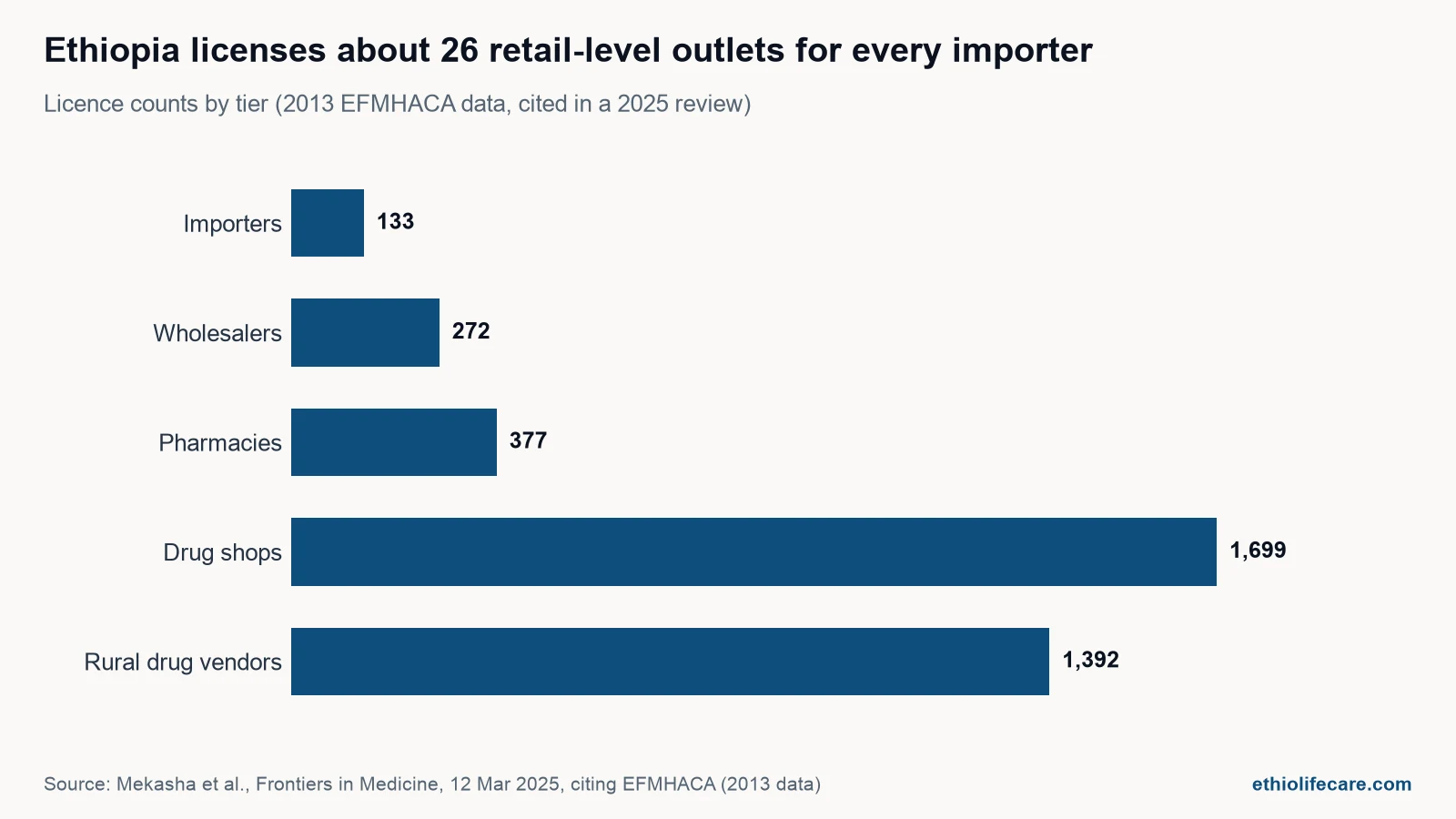
That last point is worth sitting with. The review that cites 133 importers and 272 wholesalers was published in March 2025, but its own reference list dates the underlying source to 2013. A recent academic paper repeating a twelve-year-old figure without flagging its age is exactly the kind of stale number a buyer needs to catch before treating it as current.
What the business directories actually show, checked on 22 September 2026
We opened the relevant category pages on Ethiopia’s two most-used general business directories and read the pagination counters directly rather than estimating from a search result. We tried a third, ethyp.com, and its server returned an HTTP 403 error to every fetch attempt, so it is not part of the numbers below. We did not scrape every individual listing; a directory’s own “results” counter on a category page already answers “how many.”
| Directory and category | Listings | Checked |
|---|---|---|
| 2merkato, “Medicines/Pharmaceuticals” (importer category) | 107 | 22 Sep 2026 |
| 2merkato, “Medical & Pharmaceutical Equipment & Products” | 63 | 22 Sep 2026 |
| 2merkato, “Ethiopian Manufacturers > Medicines & Pharmaceuticals” | 2 | 22 Sep 2026 |
| AddisBiz, “Pharmaceutical / Medicine Importers and Suppliers” | 181 | 22 Sep 2026 |
| AddisBiz, “Pharmaceutical Product Supplier Companies” | 56 | 22 Sep 2026 |
| AddisBiz, “Pharmaceutical Industry Manufacturers” | 24 | 22 Sep 2026 |
| AddisBiz, “Pharmacies and Drug Stores” | 37 | 22 Sep 2026 |
Two things jump out. First, a directory’s manufacturer-specific category is a fraction of its importer category on both sites: 2 listings against 107 on 2merkato, 24 against 181 on AddisBiz. General directories are built by traders adding themselves, and traders far outnumber factories in Ethiopia’s pharmaceutical sector, matching every other source in this piece. Second, AddisBiz’s pharmacy and drug store category shows only 37 outlets nationwide, a fraction of the 377 pharmacies the 2013 EFMHACA count above puts in that tier alone, before adding drug shops or rural vendors. Retail pharmacies mostly have no reason to list on a B2B import directory, so that tier is badly undercounted there, and the directory figure says little about the real number of outlets.
Deduplicating a directory sample, by hand
The question buyers actually ask is whether adding two directories together gets you closer to a real total, or just double-counts the same companies. We tested this on one category rather than claiming to have deduplicated the whole market: the 19 company names visible on page one of 2merkato’s 107-listing importer category, checked against the fuller set of names extracted from AddisBiz’s 181-listing importer category, matching on normalised company name after stripping generic words like “PLC,” “trading” and “pharmaceutical.”
Zero of the 19 matched. A handful shared only a generic word, “Bright Pharma Trading Company” and “AB Pharma PLC” both contain “Pharma,” for instance, but a name-by-name check confirmed these are different businesses. On this sample, the two directories were compiled independently, at different times, and each captured a different slice of the market. You cannot add 107 and 181 to approximate a total (that would overcount whatever overlap exists elsewhere), and you cannot assume the larger list is a superset of the smaller one. Neither directory is complete on its own.
Official counts, side by side with the directories
EFDA itself has published a named list of licensed importers and wholesalers. The version we could find and read, dated March 2019, names 206 businesses: 112 entries describe an importer function, 178 describe a wholesaler function, and many appear once holding both licences at the same address (EFDA, Importers and Wholesalers List, March 2019). EFDA also publishes a January 2025 document on regulatory measures taken against importers and wholesalers that fiscal year, but it is a scanned image file with no extractable text, so no count from it appears here.
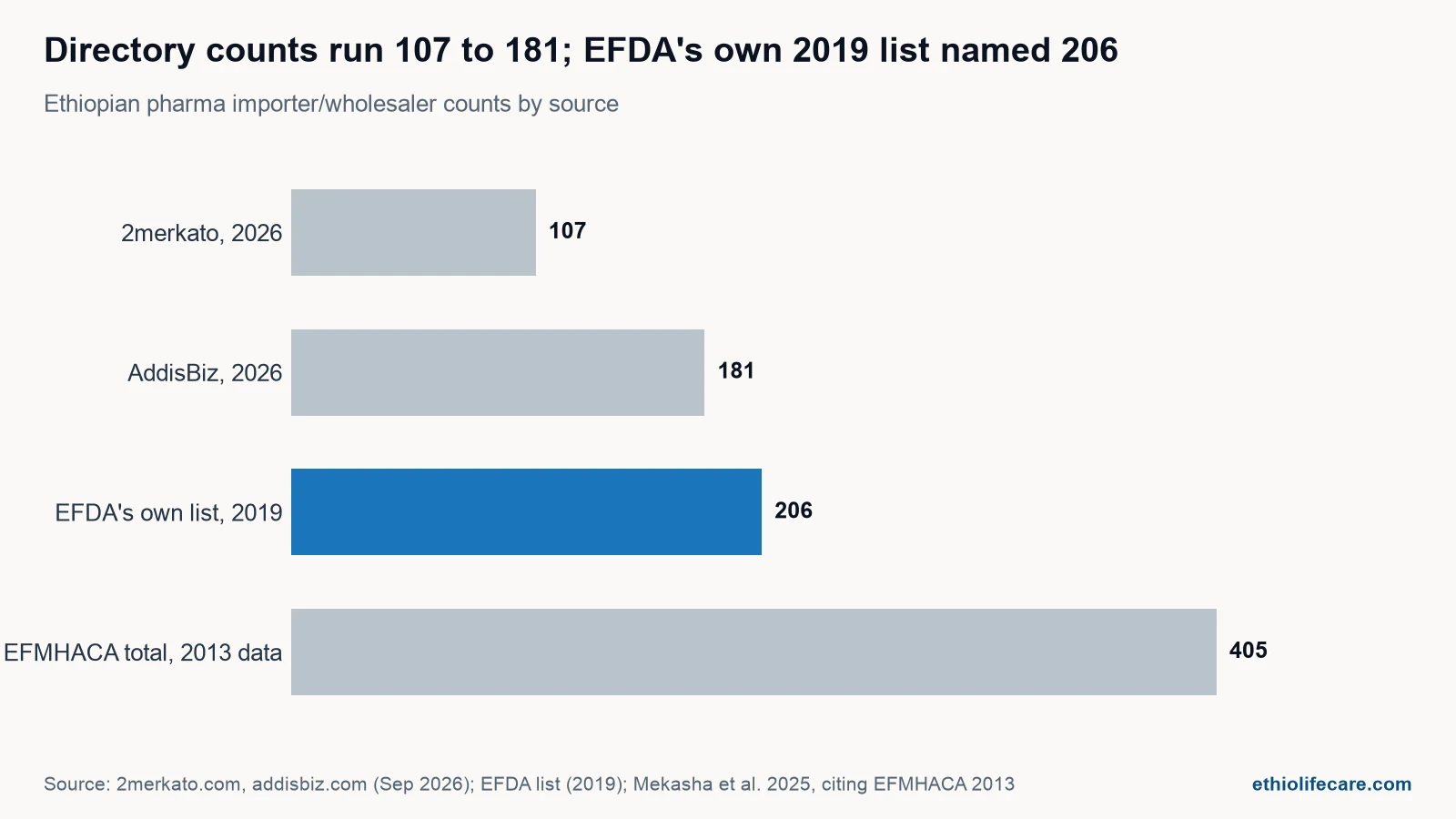
Put the two kinds of source next to each other and the gap is the actual finding of this piece, not any single number in it. Live business directories in 2026 show 107 to 181 pharmaceutical listings, depending on which one and which category. EFDA’s own named list, from 2019, sits above both at 206. A figure traceable to 2013 data puts importers and wholesalers together at 405. Every one of these is a real, sourced count, and none of them is “the” number of pharmaceutical companies in Ethiopia, because licences are issued and lapse faster than any directory, government PDF or blog post can be published and stay current. Treat every count here, including ours, as a snapshot with a date on it.
Local manufacturers: a much smaller, much newer count
Local manufacturing is where the confusion gets worse, because three credible sources give three different counts and none claims to measure the same thing. A 2015 national strategy jointly published with WHO put the starting point at “more than 200 importers, wholesalers and distributors” against just nine manufacturing companies licensed by the then-FMHACA, two of which were GMP-certified (WHO/Federal Ministry of Health, National Strategy 2015 to 2025). A 2022 review in the Ethiopian Journal of Health Sciences, drawing on a 2020 manufacturer profile study, counted 11 firms producing finished pharmaceuticals (Marew et al., Ethiop J Health Sci, September 2022). The same 2013 EFMHACA register cited above counts 32 plants “varying in size,” only 12 of them focused on generic finished dosage forms, the rest making devices, supplies, reagents, cosmetics and disinfectants.
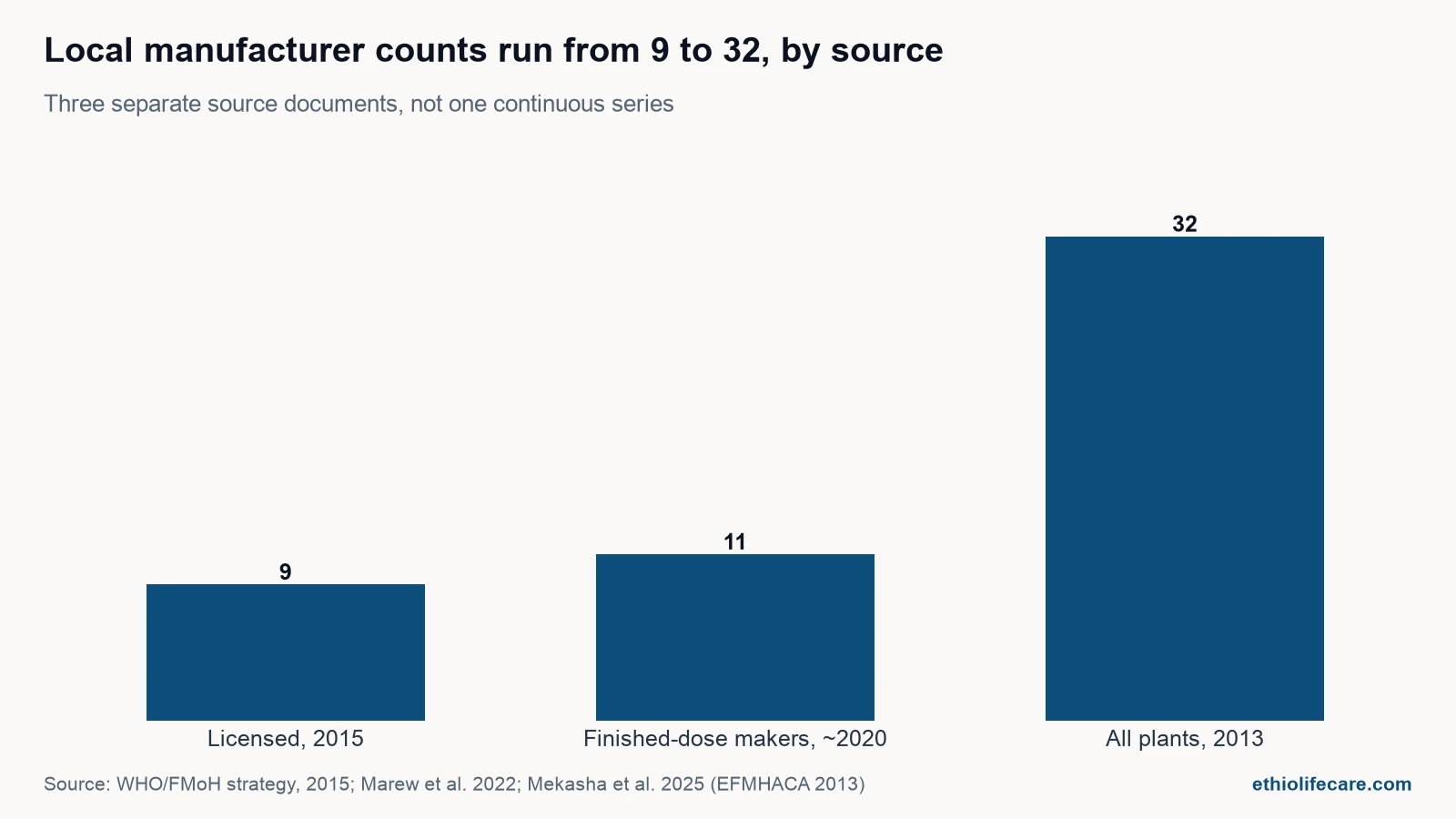
Nine, 11 and 32 are not a trend line. They are three different definitions (licensed manufacturers, firms producing finished dosage forms, and registered production establishments of any kind) measured in three different years. What every source agrees on is the direction: local production has grown from a low base, backed by the dedicated Kilinto Pharmaceutical Industrial Park and a package of tax and procurement incentives. Local production now covers more than 40% of Ethiopia’s medicine supply, and Ethiopia became the ninth African country, and the first in the IGAD region, to reach WHO Maturity Level 3 for medicines regulation in September 2025 (World Bank Group, 26 May 2026). The industry association representing local manufacturers, the Ethiopian Pharmaceuticals and Medical Supplies Manufacturers Association, is active in that push, though we could not independently confirm a current membership count for it.
Why the official count moves even when nothing changes on a shelf
A count can shift for reasons that have nothing to do with how many companies physically exist. EPSS, the government agency that buys and distributes the bulk of Ethiopia’s public-sector medicines, has been deliberately expanding its own registered supplier base, pushing more suppliers through EFDA registration specifically to close gaps on products with a persistent shortage. In an August 2026 briefing, EPSS’s director-general said the share of medicines facing inadequate supplier availability had fallen from 27%, measured roughly four years earlier, to 16% now, attributed in part to that push (The Reporter Ethiopia, August 2026). That is a live policy effort to grow the registered supplier count for specific products, running at the same time as directories quietly lose listings to closures nobody removed. Both movements are real, and neither shows up if you only look at one static list.
What this means for buyers shortlisting from hundreds of listings
A procurement officer or hospital pharmacy head scrolling through 107 to 181 directory listings is not looking at 107 to 181 viable suppliers. Some are defunct. Some are the same business listed under two names on two sites. Some import unrelated goods and added “pharmaceuticals” as a keyword. The directory count is a starting point for a search, not a vetted shortlist.
The filter that actually matters is not which directory a company appears on. It is whether EFDA has a current, product-level marketing authorization on file for the specific item you intend to buy, searchable free of charge on EFDA’s public registry at eris.efda.gov.et. A trading licence covers the business; product registration is granted item by item, and only the second one confirms the product itself has been evaluated. We set out the full checklist in how to verify a medicine supplier in Ethiopia, and the difference between the two roles a supplier can hold in pharmaceutical wholesaler versus importer in Ethiopia.
What this means for a foreign manufacturer picking an agent
For a manufacturer weighing up Ethiopia, the wide spread between directory counts and EFDA’s own list is a useful warning rather than noise. A local agent has to be a specific, registered company, not “one of roughly 150 names that show up in a search.” Whoever you appoint needs an EFDA competence certificate, a trading licence and, for renewals, a pharmacist on staff, and takes on real liability for recalls and pharmacovigilance once the agency agreement is lodged, a point covered in more depth in what an EFDA product registration actually requires. The market itself is not small: directory counts in the low hundreds sit above roughly 3,468 retail-tier licensees downstream of them on the 2013 figures, and Ethiopia’s own regulator has been assessed by WHO as functioning at Maturity Level 3. The distribution layer is crowded and uneven in quality. The demand behind it is not in question.
What we could not pin down
Three figures did not clear our bar for this piece, named here so nobody assumes we missed them by accident. A membership count for the Ethiopian Pharmaceuticals and Medical Supplies Manufacturers Association surfaced without a source page we could open and confirm, and conflicting sources named different individuals as its president, so neither appears above. EFDA’s January 2025 document on regulatory measures against importers and wholesalers exists but is a scanned PDF with no extractable text, so no number from it appears here. And ethyp.com returned an HTTP 403 error to every request, so it is absent from the comparison rather than guessed at.
LifeCare sits inside the numbers in this piece as a licensed importer, wholesaler and local manufacturer, with over 225 EFDA product registrations across pharmaceuticals, medical supplies and medical equipment, and a manufacturing site in Gulele. We are one line in every table above, not a reason to trust the table. If you want a supplier relationship that starts with a product-level EFDA check rather than a directory listing, tell us what you need.
Frequently asked questions
So how many pharmaceutical companies does Ethiopia actually have?
There is no single verified figure, because “pharmaceutical company” spans at least five licence types (importer, wholesaler, pharmacy, drug store, rural drug vendor) and every source counts a different slice at a different date. Business directories checked on 22 September 2026 show 107 to 181 listings for importers and suppliers. EFDA’s own published list, from March 2019, named 206 licensed importers and wholesalers. A figure traceable to 2013 EFMHACA data puts importers and wholesalers together at 405, and adding the retail tiers from that same source pushes the total past 3,800. Each number is real and sourced; none is current and comprehensive at the same time.
Why do 2merkato and AddisBiz show such different numbers for the same category?
They are separately compiled, self-submitted directories with no shared database, checked here on the same day: 107 listings on 2merkato’s importer category against 181 on AddisBiz’s. A sample check of 19 names from the 2merkato list found zero matches in the AddisBiz list, meaning each captures a different, partial slice of the same market, with no reliable way to prune closed listings from either site.
How many pharmaceutical manufacturers does Ethiopia have?
Between 9 and 32, depending on which source and which year. A 2015 government strategy counted 9 manufacturing companies licensed by the then-regulator. A 2022 academic review, using 2020 data, counted 11 firms producing finished pharmaceutical dosage forms. A regulator list dated 2013 counted 32 registered plants of any kind, only 12 of which made finished generic pharmaceuticals. These are three separate counting exercises, not three points on one trend line, though every source agrees local manufacturing has grown since the earliest of them.
Is a business directory listing enough to verify a pharmaceutical supplier in Ethiopia?
No. A directory listing confirms only that someone submitted a company profile at some point; it does not confirm the business is still trading, still licensed, or authorised to sell the specific product you want. The step that actually verifies a supplier is checking EFDA’s public eris.efda.gov.et registry for a current, product-level marketing authorization, which is free and needs no account.
What is the difference between a pharmaceutical importer and a wholesaler in Ethiopia?
An importer brings pharmaceuticals or medical products into Ethiopia from abroad and needs an EFDA competence certificate and trading licence to do so. A wholesaler distributes products onward to pharmacies, drug stores, hospitals and other bulk buyers within Ethiopia. Many businesses hold both licences at once, which is one reason official importer and wholesaler counts are often reported together rather than separately.